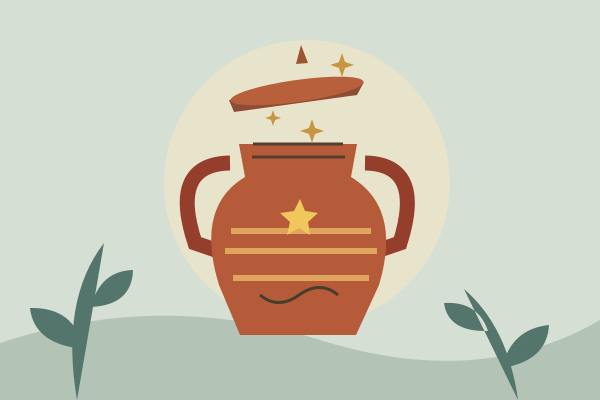
Picture Pandora’s box. It is probably small enough to carry, with a lid that should never be lifted. Now put that picture aside. In Hesiod’s Works and Days, the vessel is a great jar.
It is a small change in the image, but a useful reminder: the stories we inherit have already passed through other people’s hands. What feels original may be the shape a later retelling gave it.
What stayed inside?
In Hesiod’s account, Pandora lifts the lid. Troubles spread among mortals. Hope remains within the jar, stopped under its rim when the lid closes again.
That is where a familiar story becomes an open question. Is hope being preserved for human beings, or kept beyond their reach? The scene tells us what remains. Deciding what that means takes more work.
A story can survive for centuries without settling its own question.
The gift we keep interpreting
One way to read the image is as consolation: however difficult life becomes, hope is still there. Another reading is less comfortable. Hope can also make us wait for a future that never arrives.
Neither reading has to exhaust the story. Myths are unusually good at holding things together that an explanation wants to pull apart: comfort and anxiety, gift and trap, an ending and a beginning.
The next time someone mentions Pandora’s box, imagine the jar instead. Then ask what you think is being kept inside—and for whom.
Sources & further reading
An interpretive reading of Hesiod. The later translation history of “box” is outside this essay’s scope.
Keep asking. Keep wondering.